


result
Why Finding a “Micro Niche” Can Define a Successful Academic Career
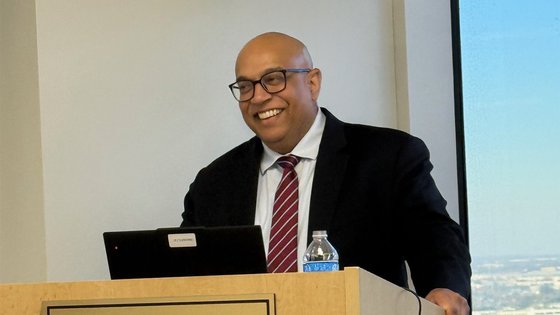
Jayakar V. Nayak, MD, PhD, discovered his path to making a difference in the field of otolaryngology early in his career, and recently spoke to Houston Methodist Hospital learners and faculty members about how he believes others can find their own “micro niche.”
“Finding that thing that ignites your curiosity is a very personal endeavor,” said Dr. Nayak, Associate Professor, Department of Otolaryngology – Head and Neck Surgery and Director of Rhinology Research at Stanford University School of Medicine. “It’s not just about the topic, but it’s also about your timing, patient population, resources, and the extent of your goals. It has to be a natural pathway.”
In his recent visiting professor talk, Dr. Nayak discussed three niche research topics that he has developed during his academic tenure at Stanford. Empty Nose Syndrome, basic science research to identify upper airway stem cells, and epithelial cell drivers of chronic rhinosinusitis are what he terms his “micro niche” areas of focus.
Dr. Nayak’s foray into Empty Nose Syndrome (ENS) happened only a month after he became an attending surgeon. Nancy, a high school patient, came to him with persistent nasal congestion that her other doctors could not explain despite past nasal surgeries. Dr. Nayak performed an office endoscopy and noted a cavernous nasal airspace due to the complete resection of the inferior turbinates (ITs). On a hunch, Dr. Nayak placed cotton plugs into Nancy’s nose, and after only 20 seconds, he witnessed an unexpectedly rapid and fascinating resolution of her past two years of nasal congestion.
It was then that Dr. Nayak realized he was likely meeting his first patient with ENS, a condition he had only read about in review books. After reviewing the limited available literature over the next year, Dr. Nayak judiciously shepherded Nancy through two limited nasal reconstruction procedures that largely resolved her nasal breathing complaints by restoring her IT tissue volume. These unexpectedly positive experiences with a single ENS patient sparked his curiosity to better understand nasal physiology, the role and importance of the ITs, and the dimensions of this complex entity of ENS.
ENS is a condition that occurs in a limited and unpredictable subset of patients after turbinate reduction surgery. Why only a small subset of patients develops this condition after the very common and successful IT reduction surgery is unclear. There also are concerning associations between ENS and psychological overtones, as noted in the literature. Were some patients somehow predisposed to this condition? Was there any evidence for this?
“I quickly realized there were many gaps in our understanding of ENS – from its basic pathophysiology to the absence of formal diagnostic criteria to evidence-based treatments to offer these patients,” Dr. Nayak said. The first step was to define the cardinal symptoms associated with ENS and then validate an office-based method of testing patients for this condition. In 2016, Dr. Nayak and his team published their validation of the six major symptoms that define ENS as the “ENS6Q 6-item questionnaire.” In 2017, this group validated the intranasal cotton test (the same test used years earlier on Nancy) and also established a scoring threshold for potentially treatable forms of ENS from IT tissue loss.
“With these accomplishments,” he said, “we, and the national and international ENT community, now have standardized, reliable tools and scoring metrics to properly evaluate patients for ENS and, if possible, also monitor their progress.” Dr. Nayak would go on to publish how placement of cartilage implants into the nasal cavity – a procedure he termed the inferior meatus augmentation procedure (IMAP) – conferred highly significant, long-term reductions in symptom scores for ENS patients.
“While debates continue with some aspects of ENS, and certainly additional research is needed, efforts from our group and others have fortunately brought increased awareness and attention to this disorder, as well as the importance of IT function/physiology,” Dr. Nayak said.
Dr. Nayak has now been referred patients from most states in the US and more than 20 different countries. His expertise in ENS also led him to his being prominently featured in the book Breath by James Nestor, a New York Times best-seller that endorses the importance of nasal breathing for overall health and well-being.
Dr. Nayak chose wet lab basic science research in rhinology as his second micro niche, and much of this is because of his MD/PhD background. After 10 years of studying stem cells in the nasal cavity, his team’s research is giving hope to families and sufferers of cystic fibrosis (CF), the most fatal genetic disorder in the US.
“An understudied area in the nasal cavity from the basic science side was stem cell biology,” he said. “What are the cells and molecules responsible for maintaining and regenerating our internal nasal lining, or mucosa?”
With help from post-doctoral scholars, fellows, and pre-med students, and guidance from pulmonary literature, Dr. Nayak’s team published some of the first studies on upper airway basal cells (UABCs), the stem cells of the nasal cavity and sinuses. His team and collaborators at Stanford are now harnessing these UABC cells in a novel capacity – treatment of CF sinusitis via stem cell transplantation.
“We are hoping to use CRISPR gene editing to splice-in a full-length, working copy of this anion transport gene into the nasal stem cells that we obtain from CF patients after routine sinus surgery.” This would potentially ‘render as normal’ the CF patients’ own UABCs, which can then be stored and later transplanted back into their sinuses in a “paradigm-shifting, permanent treatment algorithm.” For this research which has advanced for nearly 10 years, Dr. Nayak and his collaborators have received grant support from the National Institutes of Health (NIH), California Institute of Regenerative Medicine (CIRM) and the Cystic Fibrosis Foundation with publications in Cell Stem Cell and Molecular Therapy.
In a final niche area of research progress, Dr. Nayak and collaborators at Harvard and Ohio State were able to use cutting edge technology platforms such as single cell RNA sequencing and on-slide spatial transcriptomics in order to identify novel epithelial cell (rather than immune system) drivers of chronic rhinosinusitis (CRS). “Our data suggest that lesser-known Tuft cells (chemosensory cells) and basal cells/UABCs/stem cells are, in fact, major orchestrators propelling the immune cell recruitment into the CRS inflammatory microenvironment.” Now Dr. Nayak and colleagues hope to obtain NIH funding to determine if these cells and their products may serve as promising new targets for novel treatments of CRS. The latter findings were recently published in the journal Immunity.
Circling back to the notion of micro niche practice or area of pursuit in otolaryngology, Dr. Nayak agrees that this is not for everyone, but he himself is a big proponent.
“If you like to specialize, you can potentially carve out your own ’small territory,’ and with a well-designed, well-received set of studies and publications, become an authority and expert in that arena. This is likely true for every medical field in medicine, but especially so for a younger subspecialty like ours,” he said.
On the other hand, he recommends “choosing your adventure wisely. He said, “Eager patients and referring primary and otolaryngology MDs scan the literature and may soon flood your practice based on your publications.” Dr. Nayak, therefore, recommends linking your name to topics of strong personal interest when pursuing a line of investigation.
Similarly, he said, journals will seek specialist clinicians and scientists to provide reviews and comments on their numerous articles submitted for peer review. If you choose wisely, this can be an outstanding way to stay ahead of the latest research in your given micro niche. However, it also can be burdensome if this field is not a topic of major personal interest.
For his part, Dr. Nayak’s ENS-specific interests have led to more than 400 complex patient referrals and 18 peer-reviewed manuscripts and book chapters. Combined with his other broad research pursuits from basic science to surgery, this has culminated in podium presentations and awards at national meetings, as well as podcasts, webinars, and invited international talks. Dr. Nayak is a lead author/co-author on over 150 other peer-reviewed publications and serves as an invited reviewer for several medical and scientific journals.
“Of course, there’s always a high chance of failure when embarking on new challenges like a niche program, but, from my perspective, at least you failed while trying instead of not ever taking a shot,” he said. Alternatively, if you are successful, a micro niche can become a “rewarding boon to your life and career,” he said.
Dr. Nayak is a native of New Jersey and studied neurosciences as an undergraduate student at the University of Pennsylvania. He pursued his MD and a PhD in immunology at the University of Pittsburgh School of Medicine as part of the Medical Scientist Training Program, where he stayed to complete his residency in Otolaryngology – Head and Neck Surgery. He returned to Penn for one additional year for fellowship training in Rhinology/Endoscopic Sinus and Skull Base Surgery, after which he joined the faculty at Stanford in Fall 2009. He has been a tenure-track faculty member at Stanford since that time and is currently an Associate Professor in the Division of Rhinology/Endoscopic Sinus & Skull Base Surgery.


